> For the complete documentation index, see [llms.txt](https://docs.openrank.com/llms.txt). Markdown versions of documentation pages are available by appending `.md` to page URLs; this page is available as [Markdown](https://docs.openrank.com/integrations/farcaster/ranking-strategies-on-farcaster.md).
# Ranking Strategies on Farcaster
Profile reputation scoring to address trustworthiness in social networks
## **Defining Ranking Strategies**
We have implemented a set of strategies that can reveal high quality (highly ranked) profiles from the entire Farcaster network. These ranking strategies are based on [**following**](#strategy-following) and [**engagement**](#strategy-engagement) reputation graphs.
## **How are the Rankings performed?**
We use Farcaster social graph data and use a linear combination of peer-to-peer actions such as Follows, Recasts, Mentions, Comments to calculate a personalized reputation graph for each user. This helps in figuring your own network or friends and friends of friends. We then apply EigenTrust on these graphs to generate a ranking of users.
Developers can change the algorithm weights and the rankings change real-time based on the updated parameters.
{% hint style="info" %}
To see how this is done in our codebase, checkout the repo on our `farcaster-graph` [GitHub repo](https://github.com/Karma3Labs/farcaster-graph), specifically on [these lines of code](https://github.com/Karma3Labs/farcaster-graph/blob/main/pipeline/globaltrust/compute.py#L108-L118)
{% endhint %}
### Seeding the Rankings
For Ranking the entire set of Farcaster profiles (Global Ranking), we use a seed peer set of profiles. For Personalized Ranking, the seed peer is the profile(s) itself.
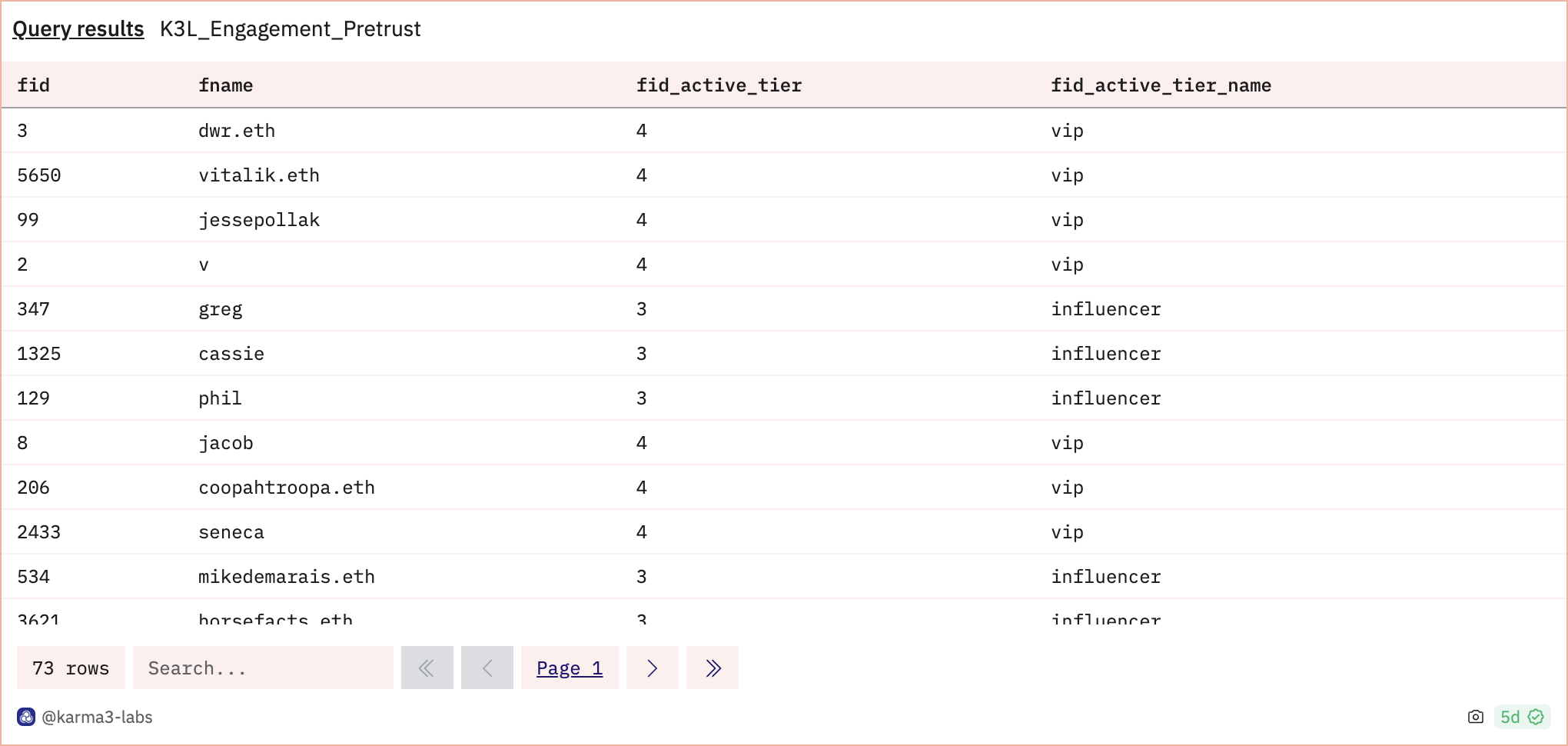
The Global Profile Ranking compute is seeded with a few profiles chosen as a starting point to begin the computation of transitive trust among profiles. This seed peer selection is upto the developers. But for simplicity, we have currently chosen a curated list of profiles using the Dune [Farcaster Explorer dashboard](https://dune.com/ilemi/farcaster-explorer). The seed peers are the influencers and VIPs retrieved via this query on [Dune](https://dune.com/queries):
```sql
SELECT
fid, fname, fid_active_tier,
CASE
WHEN fid_active_tier = 3 THEN 'influencer' ELSE 'vip'
END AS fid_active_tier_name
FROM
query_3418402
WHERE
fid_active_tier in (3,4)
LIMIT 100
```
as a result, these are the sample of the seed users loaded into a `pretrust` table (as seen in the [db\_schema.sql](https://github.com/Karma3Labs/farcaster-graph/blob/main/db_schema.sql#L340-L347))
Sample Influencers and VIPs picked as seed trusted users for Profile Ranking using OpenRank
### Strategy: **following**
This strategy emphasizes only on `following` as peer-to-peer trust heuristics, disregarding all other actions such as `likes`, `replies`, `recasts` and `mentions`.
{% hint style="info" %}
***Weight Assignments:** Follows = 1*
{% endhint %}
You can see the weight assignments [here in the code](https://github.com/Karma3Labs/farcaster-graph/blob/main/pipeline/globaltrust/compute.py#L77-L83).
### Strategy: engagement
This strategy emphasizes on engagement actions as peer-to-peer trust heuristics, by combining `likes`, `replies`, `recasts`, `mentions` and `follows`. The more engagement a profile receives on their casts, the more they inherit trustworthiness from the source profile, but weighted by the trustworthiness or reputation of the source as well.
Therefore, if a set of sybil or spam clusters boost a particular profile (say Alice) and their casts, Alice's ranking will likely not increase because of the low rank of the profiles which are engaging with Alice.
{% hint style="info" %}
***Weight Assignments:** Likes = 1, Replies = 6, Recasts = 3, Mentions = 12, Follows = 1*
{% endhint %}
You can see the weight assignments [here in the code](https://github.com/Karma3Labs/farcaster-graph/blob/main/pipeline/globaltrust/compute.py#L88-L93). Developers can also change the weights in the algorithms.
Ranking Scope includes [Global](/integrations/farcaster/global-profile-ranking.md) and [Personalized](/integrations/farcaster/personalized-network.md), you can know more about them in their respective sections.
{% hint style="info" %}
Tryout the APIs here! —
{% endhint %}